

Executive Course: The New Space Race: Economic, Policy, and Security Issues on the Final Frontier
Although few of us have visited it, space is vital to nearly all aspects of our Earth-bound way of life. The global space economy is projected to reach $1 trillion dollars by the end of the decade, and according to the Chamber of Commerce investment in commercial space firms has seen “explosive growth in recent years.” The increasing importance of space to our national security is exemplified by the creation of the United States Space Force in 2019, the first new branch of the military since 1947.
The economic, security and policy implications of this latest race in space are the focus of this must-attend seminar, which will provide the opportunity to explore congressional, White House, industry, and international perspectives on the importance of space to our future. Conducted under “Chatham House rules” of non-attribution, this seminar will afford participants the rare opportunity to hear from and interact with the nation’s premier experts on space. To encourage dialogue and enhance the intimacy of the format, attendance will be limited to the first 50 applicants.
Course Information
Course Dates | March 20-21, 2024 |
Registration Deadline | March 15, 2024 |
Location | Potomac Institute for Policy Studies 901 N Stuart Street Arlington VA, 22203 |
Course Director | John Paul "JP" Parker |
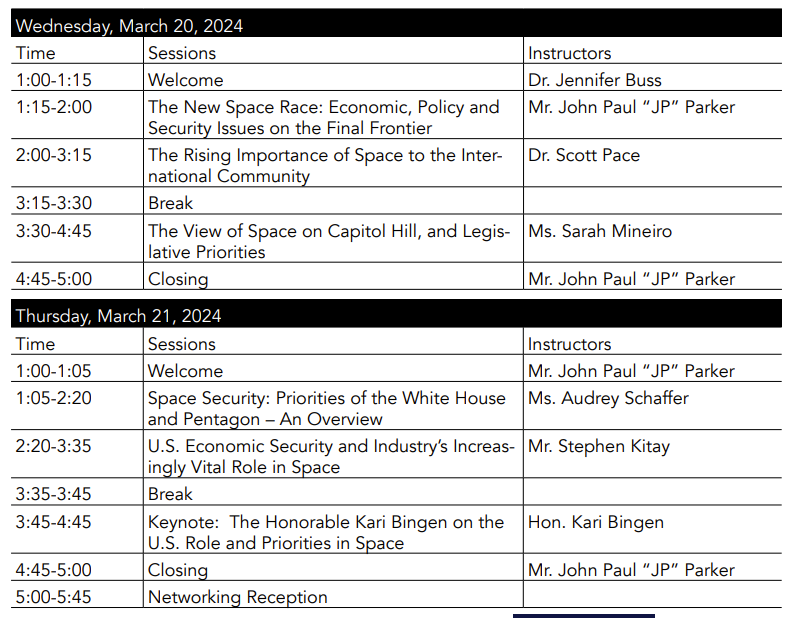
Course Agenda
Faculty
Hon. Kari Bingen is the director of the Aerospace Security Project and a senior fellow in the International Security Program at the Center for Strategic and International Studies (CSIS). She joined CSIS from HawkEye 360, an innovative space technology company creating a new class of radio frequency (RF) data and analytics, where she was the chief strategy officer. Prior to the private sector, Kari served as the deputy undersecretary of defense for intelligence and security, overseeing the defense intelligence and security enterprises, comprising more than 120,000 personnel and an annual budget of over $54 billion. Before that, Kari served as the policy director on the House Armed Services Committee and staff lead for its Strategic Forces Subcommittee, advising members of Congress on defense policy, program, and budget matters. Prior to entering government, Kari specialized in national security space issues, working with U.S. defense and intelligence community clients, first as a space systems analyst at SRA International’s Adroit C4ISR Center, and then as a senior space policy analyst at the Aerospace Corporation.In addition to her work at CSIS, Kari is an adjunct assistant professor at Georgetown University. She is a member of the U.S. Strategic Command Strategic Advisory Group, was a commissioner on the CSIS Technology and Intelligence Task Force, and serves on a number of corporate and nonprofit advisory boards. She graduated from the Massachusetts Institute of Technology with a degree in aeronautics and astronautics and was a 2002 National Reconnaissance Office technology fellow.
Mrs. Sarah Mineiro is the CEO and owner of Tanagra Enterprises, a defense, intelligence, space, science and technology research and consulting firm based in Washington, D.C. Sarah has worked within the national security and defense sector for more than 20 years. Over her career Sarah has worked in private industry, the Executive, and Legislative branches of government. Previously, Sarah was the Senior Director of Space Strategy for Anduril Industries, a hypergrowth VGbacked defense unicorn specializing in Al/ML enabled defense technologies. Sarah was the Staff Lead for the Strategic Forces Subcommittee for the House Armed Service Committee {HASC). She led the Subcommittee's legislative and oversight activities of all Department of Defense and Military Intelligence Program space programs, U.S. nuclear weapons, missile defense, directed energy, and hypersonic systems. In this role she was the primary drafter and negotiator of the Space Force and Space Command legislation for the House Republicans.Prior to joining the HASC, Sarah served in the Office of the Under Secretary of Defense for Policy (OSDP), the Under Secretary of the Air Force for International Affairs (SAF/IA), and Sarah started her career as an intelligence analyst for the National Air and Space Intelligence Center. Sarah is an angel investor, member of several corporate boards, the Defense Business Board, the Defense Innovation Board, and serves as a non-resident fellow with CSIS.
Dr. Scott Pace is the Director of the Space Policy Institute and a Professor of the Practice of International Affairs at George Washington University’s Elliott School of International Affairs. He is also a member of the faculty of the Trachtenberg School of Public Policy and Public Administration. His research interests include civil, commercial, and national security space policy, and the management of technical innovation. Dr. Pace rejoined the faculty of the Elliott School in January 2021 after serving as Deputy Assistant to the President and Executive Secretary of the National Space Council from 2017-2020. From 2005-2008, he served as the Associate Administrator for Program Analysis and Evaluation at NASA. Prior to NASA, Dr. Pace was the Assistant Director for Space and Aeronautics in the White House Office of Science and Technology Policy (OSTP). From 1993-2000, Dr. Pace worked for the RAND Corporation's Science and Technology Policy Institute (STPI). From 1990 to 1993, Dr. Pace served as the Deputy Director and Acting Director of the Office of Space Commerce, in the Office of the Deputy Secretary of the Department of Commerce. He received a Bachelor of Science degree in Physics from Harvey Mudd College in 1980; Master’s degrees in Aeronautics & Astronautics and Technology & Policy from the Massachusetts Institute of Technology in 1982; and a Doctorate in Policy Analysis from the RAND Graduate School in 1989.
Mr. Stephen Kitay is the Senior Director of Azure Space at Microsoft. Before this position, he was a member of the Senior Executive Service as the Deputy Assistant Secretary of Defense (DASD) for Space Policy where he had a key leadership role in the establishment of the U.S. Space Force. As the DASD Space Policy, he was responsible for establishing policy and guidance to assure U.S. and allied warfighters the benefits of space capabilities and to guide the Department’s strategy for addressing space-related issues. He also led Departmental activities in international space cooperation. Mr. Kitay was also an active duty Air Force military officer and held civilian positions in the Intelligence Community and on Capitol Hill.
Mr. John Paul “JP” Parker is the founder and CEO of Escape Velocity, a boutique national security advisory firm. Prior to this he spent 14 years in industry and 18 years in government.He is all about the mission, and his current mission is to marshal his extensive and diverse industry and government experience on behalf of innovators and patriots.In 2018, at the request of the Director of National Intelligence, JP founded and served as the first-ever U.S. Intelligence Community Space Executive. The Space Executive is the principal space policy advisor to the Director of National Intelligence and also serves as the National Intelligence Manager (NIM) for space related threats to national security.Previously, JP served as Special Advisor for Space, Cyber, Intelligence, Weapons of Mass Destruction, and Science and Technology to the Vice President of the United States. In addition to representing the Vice President on national security matters addressed by the National Security Council, JP had leadership roles in reestablishing the National Space Council, drafting the National Strategy for Space, and helping update the national cybersecurity strategy for the U.S.Prior to the White House appointment, JP was the founding Technical Director of the Intelligence Community Security Coordination Center, which was created to coordinate the cyber defense of the 17 agencies comprising the U.S. Intelligence Community, and which is one of seven Presidentially designated Federal Cybersecurity Centers.
Ms. Audrey M. Schaffer is an internationally recognized expert in space policy with experience across the civil, commercial, and national security space sectors. She is currently the vice president of Strategy and Policy at Slingshot Aerospace, the innovative technology company building world-class space data, simulation, and analytics products to make space operations safer, optimize orbital operations, and accelerate space sustainability.Before joining the private sector, Ms. Schaffer served in the U.S. government for over 15 years, holding positions in the Executive Office of the President, Department of Defense, Department of State, and NASA. She most recently was the director for Space Policy on the National Security Council staff. During her time in government, she led the department's efforts to establish in law the U.S. Space Force as a new branch of the armed forces; established the U.S. policy to refrain from destructive, direct-ascent anti-satellite missile testing; represented the United States in negotiating the first-ever UN guidelines for space sustainability; and drafted numerous national and departmental space policies and strategies, including guidance approved by the president. Ms. Schaffer holds a BS in Aerospace Engineering from the Massachusetts Institute of Technology and a MA in International Science and Technology Policy from the George Washington University. She began her career as a Presidential Management Fellow and is a recipient of the Secretary of Defense Medal for Meritorious Civilian Service.